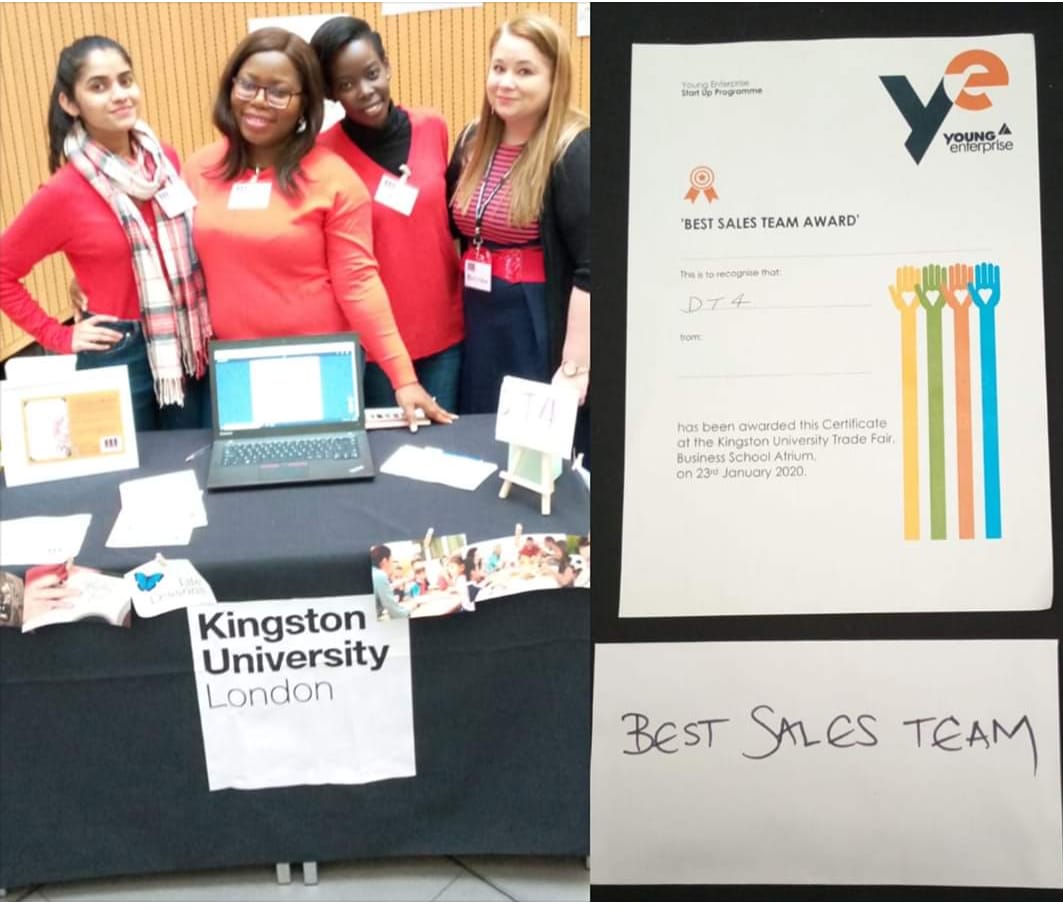
On Thursday the 28th of January my team participated in a trade fair competition at Kingston University’s Business School Atrium. This was a first for me because I had never sold anything at a trade fair before and was not exactly sure what to expect standing on the other side of the table. We had just come from the Bright Ideas Sprint Weekend some ideas on how to take our product forward and so this was going to be the first place to sort of test those ideas out. Also, we wanted to be able to leave with some valuable insights from the patrons who were going to visit our stand.
The caveat was we did not have a product yet, we had commissioned a graphics designer to help us out but due to poor health, the designer missed our deadline and what little was sent had a bunch of errors in them. This leads me to my first lesson;
- Always have a plan B: In a New York Times interview with Ilene Gordon, C.E.O. of Ingredion, she highlighted the importance of having a plan B as a business person. She advises entrepreneurs to always have a backup plan that they can implement and even a plan C or D. She reasons that in the business world, our plans are subject to external factors such as government policies, and competitors’ activities just to mention a few. In our case a vendor had failed us and so we had to quickly come up with a new play – market research.
- Practice, practice, practice – So our team won the “best sales team award”. We had previously worked on a script for pitching our ideas and everyone had a part to memorize and digest. Sometimes you may have the answers to certain questions but in the heat of the moment, you could communicate your response wrongly to your audience. Therefore, it was for crucial for the team to practice the sales pitch because you never know who might be standing in the elevator next to you.
- Learn to filter feedback – Without feedback from representatives of our target market, our lecturer, judges and coaches, we may not have been able to get our prototype to where it is today. However, I learned that different demographics will have a different opinion on what direction your product should go or with features your product should have. This is in tandem with an article from the Interaction Design Foundation that suggests testing prototypes on the right people as best practice. They reason that the demographic you test your ideas on could impact the usefulness and use-ability of your product. The article gave some clear insight as to why our audience during the trade fair which were predominantly younger people would want us to produce our journal of memoirs in digital format.
- Sell Projects not Products – This has to do with with helping to meet a specific need. When a startup focuses on meeting needs as opposed to just selling products, they are able to maintain their revenue pipeline and create new streams. According to this HBR article , when businesses take the project approach to selling, they are more open to identifying and recognizing new business models that can be beneficial to the company. In applying this technique during our trade fair we found a niche in a younger demographic that could lead to a series of similar products but tailored for different age groups.
It was a good event overall, despite the many constraints we faced but then again, this was what real life is all about; your ability as an entrepreneur to scale various business challenges as they arise.
Leave a Reply